
Advanced PRONOM
Last updated on 2026-09-21 | Edit this page
Estimated time: 10 minutes
Overview
Questions
- What’s left to learn?
- What other considerations are there when documenting file format signatures?
Objectives
- Identify new learning objectives.
Priorities
Signatures will also makes use of a priority over another file format which allows tools using PRONOM to enforce a single identification for a file, e.g. Scalabale Vector Graphics (SVG) (a format based on XML) has a priority over XML to prevent SVG being identified as XML when it can be identified more specifically.
To that end, you will often see priorities over core file formats such as HTML, PDF, JPEG, TIFF, OLE2, and so on, as many other file format variants will be written on top of those.
The complete picture
When you’ve completed your efforts, a complete PRONOM record is a combination of signature & priorities & descriptive information (metadata) about the file format.
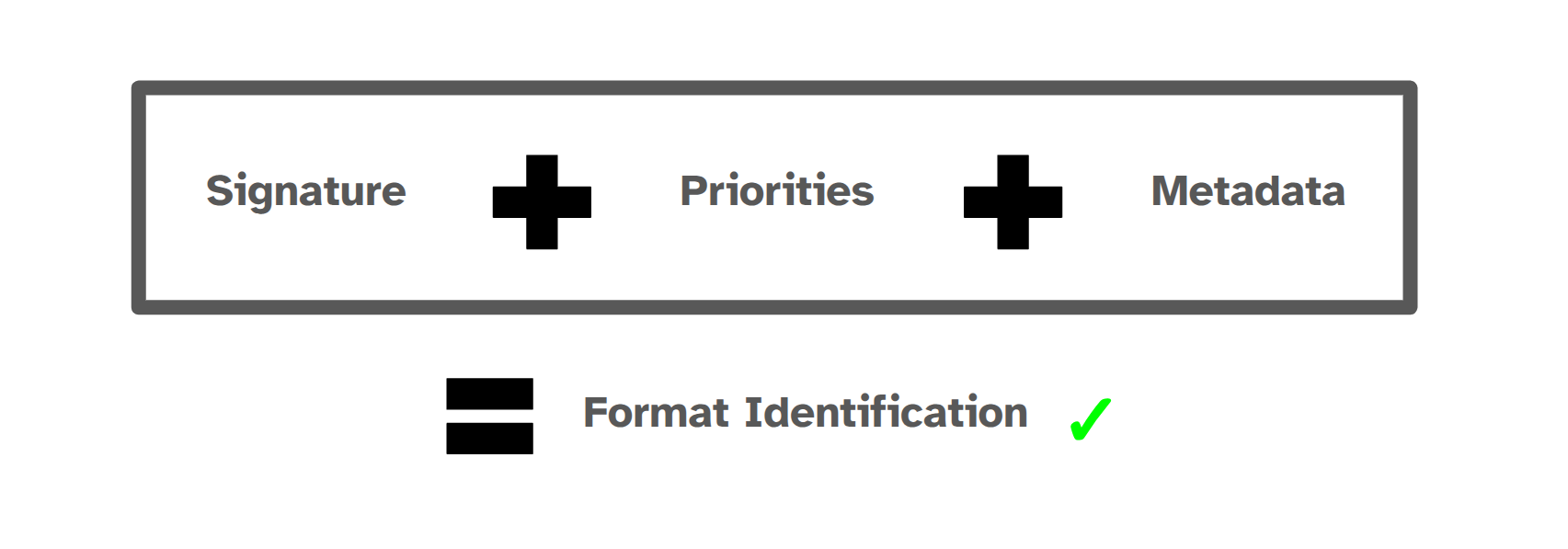
When you submit a new signature to PRONOM, you will get feel for the information they are looking for. The PRONOM team will help you.
Where to submit a signature to PRONOM
The PRONOM team prefers to receive submissions via GitHub, though if you aren’t comfortable creating a GitHub account then they can also receive information via email at
Visit this site for more information on submitting to PRONOM via GitHub.
Information to submit to PRONOM
- Format name
- Version number
- Extensions
- MIME/Media Type
- Description
- Format type
- Vendor
- File format identification signatures (preferably the sequences by themselves, the xml is only a nice addition for testing)
- Relevant links, documentation, extra information
- Credit
Of these, Format name is absolutely mandatory and the rest are nice to have, but the more information you can provide, the better! If you’ve created any file format signatures it will be useful to describe your thought process and links to any relevant documentation, such as format specifications.
Container signatures
Many of the techniques used for standard signatures and signature development can be applied to container files. Container files are formats built on top of technologies such as ZIP and OLE2 whose contents can be queried to provide more accurate identification.
Container signatures take some additional effort to research and test. We will endeavor to follow up this learning resource with a similar one containing all of the information from our previous workshop: PRONOM: What’s in the Box?
Recording your progress
The PRONOM Research repository is a great place to have discussions about file forrmats you are working on, as well as request new entries or updated ones.
Some researchers, such as Tyler, maintain their own GitHub repositories for file format research. This is useful as it provides them with a way to:
- record information,
- store sample signature files,
- store sample files.
It provides something to point to, and a way to keep track of your own efforts.
Just Solve It: File Formats, and COPTR
Two complementary resources to this work are the Just Solve It wiki by Archive Team:
And COPTR (Community-Owned digital Preservation Tool Registry) by the Open Preservation Foundation:
As you research your file formats, you might find more information about them that doesn’t sit easily on the PRONOM website. The community can benefit from this information as well.
Just Solve It: File Formats
The Just Solve It wiki primarily captures information about file formats.
Information you might record here are other details about them, including:
- links to specifications,
- links to more sample files,
- links to Wikidata records,
- software,
- and so on…
COPTR
COPTR on the other hand records information about software that can help us preserve different aspects of files and file formats.
If there are software packages connected to your format that also serve some sort of preservation purpose, e.g. provide metadata extract, then you might want to add these to COPTR’s wiki as well.
One way that both the Just Solve It and COPTR wikis benefit the community is that they are easily editable and can help us maximize the information we collect about our respective preservation challenges. They allow the community to benefit from this knowledge immediately while the PRONOM team takes the time to test and verify signature-related information and add those resources to PRONOM. They can also help us to record details early on while we still don’t have a PRONOM signature ready to submit.
- Much of this effort is researching files and writing a signature, but another big part is testing, calibration, AND documentation.
- The Just Solve It and COPTR wikis are complimentary resources that can be used as landing zones as we collect information early on about file format signatures or as we develop them.
- The FAQ and Glossary are available for quick reference whenever you need them in your signature development journey.