
Hexadecimal
Last updated on 2026-09-21 | Edit this page
Overview
Questions
- What is hexadecimal?
- What are the basics of hexadecimal?
- Why is hexadecimal important to look at files?
Objectives
- Learn what hexadecimal is.
- Learn how to construct a hexadecimal sequence with arbitrary meaning.
Introduction to hexadecimal
- Hexadecimal is a way of representing numbers.
- Hexadecimal uses 16 symbols (0-9 and A-F) compared to the 10 symbols (0-9) familiar in the decimal number system.
- Just as decimal is otherwerise known as Base10, hexadecimal is just Base16.
| DEC | 0 | 1 | 2 | 3 | 4 | 5 | 6 | 7 | 8 | 9 | 10 | 11 | 12 | 13 | 14 | 15 |
| HEX | 0 | 1 | 2 | 3 | 4 | 5 | 6 | 7 | 8 | 9 | A | B | C | D | E | F |
| DEC | 16 | 17 | 18 | 19 | 20 | 21 | 22 | 23 | 24 | 25 | 26 | 27 | 28 | 29 | 30 | 31 |
| HEX | 10 | 11 | 12 | 13 | 14 | 15 | 16 | 17 | 18 | 19 | 1A | 1B | 1C | 1D | 1E | 1F |
- While you can learn to convert decimal to hexadecimal, you are more likely to convert hexadecimal to decimal when looking at file formats.
0x00 = (16 x 0 = 0) + (1 x 0 = 1) = 0
0x01 = (16 x 0 = 0) + (1 x 1 = 1) = 1
0x0A = (16 x 0 = 0) + (1 x 10 = 10) = 10
0xFF = (16 x 15 = 240) + (1 x 15 = 15) = 255Try it in your search engine
If you use a search engine, what results do you get for the following queries?
0xFF in decimal42 in hexadecimal82 in binary0b1100 in decimal
Search engines can conveniently do the work of converting from decimal to hexadecimal and back for you. You can also investigate binary numbers quickly and easily this way without having to work out the layout of bits.
Zero to hero!
Zero is an important number in computer science and we will see it often when we analyse digital records.
What does 0x mean?
We use the 0x prefix to signify hexadecimal. When we
document hex sequences like above 0xE4 0xB8 0x96 is also
equivalent to 0xE4B896. How you choose write this
information depends on context.
You also saw 0b as a prefix. This is used to denote
binary (Base2),
e.g. 0b1100 equals 0x0C equals
12.
- A pair of hexadecimal numbers is a convenient representation of 1-byte, i.e. 8 bits of binary which is the smallest and most convenient unit of data used in computer memory.
Binary
- Binary uses 2 symbols, 0 and 1.
- Binary can otherwise be referred to as Base2. We won’t explore binary in detail here, but if you ever want to look at the binary representation of a number, modern search engines can do the conversion for you if you ask: 255 in binary (just as you can ask: 255 in hexadecimal.
ASCII lookup table
That might feel like a lot, but before we have to convert numbers every which way, we have another tool at our disposal, a lookup table which is still relevant in our research.
In the lookup table below (the ASCII table) you can see how bytes take on more meaning to a computer, e.g. as control symbols, punctuation symbols, numbers, and letters.
For the numbers and letters, this is just one encoding. We will talk about the importance of that below but first let’s look at the table for a second.
question
When you look at the table, think about your favorite (decimal) number.
- What symbol does it represent?
- What’s your favourite (hexadecimal) number, what symbol does it represent?
ASCII table
| Dec | Hex | Char | Dec | Hex | Char | Dec | Hex | Char | Dec | Hex | Char | Dec | Hex | Char |
|---|---|---|---|---|---|---|---|---|---|---|---|---|---|---|
| 0 | 0 | NUL | 25 | 19 | EM | 51 | 33 | 3 | 77 | 4D | M | 103 | 67 | g |
| 1 | 1 | SOH | 26 | 1A | SUB | 52 | 34 | 4 | 78 | 4E | N | 104 | 68 | h |
| 2 | 2 | STX | 27 | 1B | ESC | 53 | 35 | 5 | 79 | 4F | O | 105 | 69 | i |
| 3 | 3 | ETX | 28 | 1C | FS | 54 | 36 | 6 | 80 | 50 | P | 106 | 6A | j |
| 4 | 4 | EOT | 29 | 1D | GS | 55 | 37 | 7 | 81 | 51 | Q | 107 | 6B | k |
| 5 | 5 | ENQ | 30 | 1E | RS | 56 | 38 | 8 | 82 | 52 | R | 108 | 6C | l |
| 6 | 6 | ACK | 31 | 1F | US | 57 | 39 | 9 | 83 | 53 | S | 109 | 6D | m |
| 7 | 7 | BEL | 32 | 20 | space | 58 | 3A | : | 84 | 54 | T | 110 | 6E | n |
| 8 | 8 | BS | 33 | 21 | ! | 59 | 3B | ; | 85 | 55 | U | 111 | 6F | o |
| 9 | 9 | HT | 34 | 22 | ” | 60 | 3C | < | 86 | 56 | V | 112 | 70 | p |
| 10 | 0A | LF | 35 | 23 | # | 61 | 3D | = | 87 | 57 | W | 113 | 71 | q |
| 11 | 0B | VT | 36 | 24 | $ | 62 | 3E | > | 88 | 58 | X | 114 | 72 | r |
| 12 | 0C | FF | 37 | 25 | % | 63 | 3F | ? | 89 | 59 | Y | 115 | 73 | s |
| 13 | 0D | CR | 38 | 26 | & | 64 | 40 | @ | 90 | 5A | Z | 116 | 74 | t |
| 14 | 0E | SO | 39 | 27 | 65 | 41 | A | 91 | 5B | [ | 117 | 75 | u | |
| 15 | 0F | SI | 40 | 28 | ( | 66 | 42 | B | 92 | 5C | \ | 118 | 76 | v |
| 16 | 10 | DLE | 41 | 29 | ) | 67 | 43 | C | 93 | 5D | ] | 119 | 77 | w |
| 17 | 11 | DC1 | 42 | 2A | * | 68 | 44 | D | 94 | 5E | ^ | 120 | 78 | x |
| 18 | 12 | DC2 | 43 | 2B | + | 69 | 45 | E | 95 | 5F | _ | 121 | 79 | y |
| 19 | 13 | DC3 | 44 | 2C | , | 70 | 46 | F | 96 | 60 | ` | 122 | 7A | z |
| 20 | 14 | DC4 | 45 | 2D | - | 71 | 47 | G | 97 | 61 | a | 123 | 7B | { |
| 21 | 15 | NAK | 46 | 2E | . | 72 | 48 | H | 98 | 62 | b | 124 | 7C | |
| 22 | 16 | SYN | 47 | 2F | / | 73 | 49 | I | 99 | 63 | c | 125 | 7D | } |
| 23 | 17 | ETB | 48 | 30 | 0 | 74 | 4A | J | 100 | 64 | d | 126 | 7E | ~ |
| 24 | 18 | CAN | 49 | 31 | 1 | 75 | 4B | K | 101 | 65 | e | 127 | 7F | DEL |
| 50 | 32 | 76 | 4C | L | 102 | 66 | f |
Magic Numbers
To do file format research we look at the structure of the files in hex
- Files have reoccurring byte patterns within them that show us what they are
- Computers read bytes to render on your screen in a similar way to how we might read a letter. A pre-known structure that helps disseminate the information.
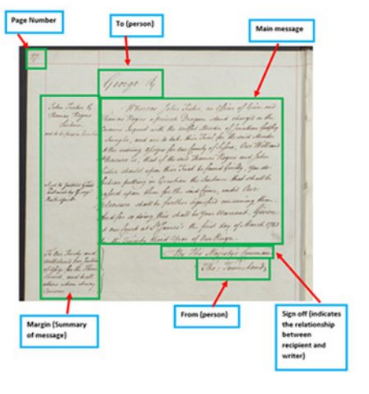 |
| How humans read a file |
 |
 |
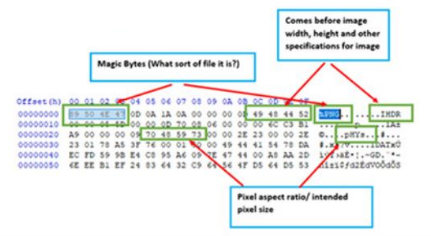 |
| How computers read a file |
Famous Byte sequences
D0CF11E0IIMMGIF89a-
PKThese are all ‘Magic Numbers’ - sequences that the format developers have chosen for quick identification of their file formats.
- Microsoft Office
- TIFF
- Also TIFF!
- GIF
- ZIP
Magic numbers: your first file format signatures
You will begin to recognize these sequences in your file format research!
Putting it together
Can you use the ASCII table above to construct a byte-sequence?
Challenge
Write down the hexadecimal sequence for “Hello world”.
48 65 6C 6C 6F 20 77 6F 72 6C 64- Hexadecimal is a number system.
- Hexadecimal makes it easier to understand “binary”.
- Hexadecimal is mapped to signals and characters that have meaning to a computer.
- Hexadecimal can take on arbitrary meaning through “encodings”.
- Hexadecimal is the foundation for a PRONOM signature!